
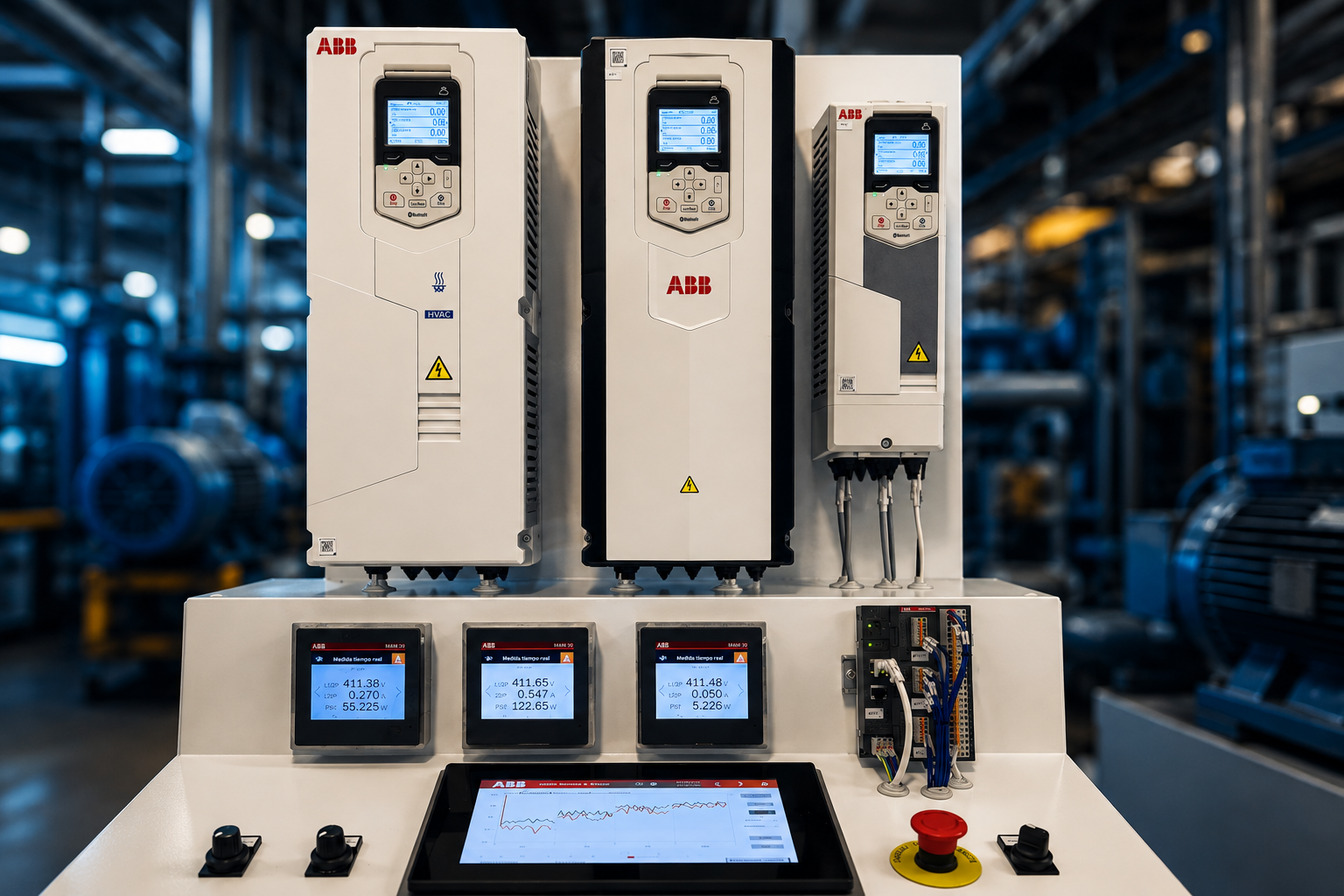
In recent years, energy efficiency has ceased to be solely a commitment to sustainability and has become a strategic factor for business competitiveness. The increase in energy costs, combined with the need to optimize production processes, has led many industries to ask how to reduce consumption without making large investments.
The good news is that, in many cases, it is not necessary to replace existing machinery.
One of the most effective solutions consists of optimizing the operation of electric motors using variable frequency drives, a technology that allows the motor speed to be adapted to the actual process demand. The result is lower energy consumption, longer equipment life, and better production control.
Why do some motors consume more energy than necessary?
Electric motors represent a very significant portion of the energy consumption of an industrial plant. They are present in pumps, fans, conveyor belts, compressors, HVAC systems, and many other applications.
However, in numerous installations these motors always operate at maximum speed, even when the process does not require all that capacity.
It is like driving a car in the city while keeping the accelerator fully pressed and regulating speed only with the brake. The vehicle continues to consume fuel unnecessarily and its components suffer greater wear.
Something similar happens with motors: constantly working at 100% implies higher electrical consumption and mechanical stress that, in many cases, could be avoided.
What is a variable frequency drive?
A variable frequency drive (VFD) is an electronic device that regulates the speed of an electric motor by adjusting the frequency and voltage it receives.
Instead of making the motor always operate at maximum performance, the drive automatically adapts its speed to the actual process requirements.
If a pump only needs to deliver 70% of the flow, the motor will work at that speed. If a fan requires less airflow, it will reduce its revolutions without losing system control.
This continuous adjustment allows energy consumption to be optimized and the overall efficiency of the installation to be improved.
More than energy savings: five advantages that make a difference
Although electricity savings is usually the main reason for installing a drive, its benefits go much further.
- Lower energy consumption: the motor only uses the energy necessary to perform its work.
- Longer machinery life: starts and stops are smoother, reducing stress on motors, bearings, belts, and transmissions.
- Fewer breakdowns: by reducing vibrations and mechanical stress, component wear is also reduced.
- Greater process control: speed can be adjusted precisely to adapt to each production phase.
- Reduced emissions: consuming less electricity also means reducing the environmental impact associated with industrial activity.
Practical case: a small change with a big impact
Imagine a food industry with a ventilation system that operates 16 hours a day.
The fan is driven by a 22 kW motor and constantly works at 100% of its speed, although for much of the day it is not necessary to move the maximum airflow.
After analyzing the process, a variable frequency drive is installed that automatically adapts the motor speed according to actual demand.
Before
- Motor always running at 100%.
- Higher electrical consumption.
- Abrupt starts.
- More wear on bearings and belts.
- Regulation using mechanical dampers.
After
- Speed adjusted to actual need.
- Lower energy consumption.
- Progressive starts.
- Less mechanical wear.
- Greater process stability.
- Reduced maintenance tasks.
Although the savings will depend on each installation, this type of application usually offers a particularly attractive return on investment when the motor operates many hours per year and process demand varies.
In which applications is it worthwhile to install a drive?
Variable frequency drives offer better results in equipment whose operation changes throughout the day.
Some examples are:
- Water pumps.
- Industrial fans.
- HVAC systems.
- Cooling towers.
- Compressors.
- Conveyor belts.
- Mixers.
- Industrial ventilation equipment.
If your installation regulates flows using valves, dampers, or throttling, there is probably room to improve its efficiency.
Why trust an ABB drive?
Once the savings opportunity has been identified, choosing the right equipment is essential.
ABB is one of the world’s leading manufacturers of industrial drives thanks to its experience, reliability, and ability to adapt to multiple sectors.
Its drives stand out for:
- High energy efficiency.
- Intelligent control functions.
- Smooth start and stop.
- Simple integration with automation systems.
- Wide power range.
- High reliability in industrial applications.
In addition, they incorporate monitoring tools that help optimize motor operation and facilitate maintenance tasks.
Conclusion
Reducing energy consumption does not always mean replacing machinery or making large investments.
In many installations, optimizing motor operation using a variable frequency drive can become one of the most cost-effective measures to improve efficiency, reduce mechanical wear, and lower operating costs.
Each process is different and, therefore, it is important to analyze the actual needs of the installation before selecting the appropriate solution.
At ROYSE, as an ABB distributor, we make available to industry a wide range of variable frequency drives and the technical advice necessary to identify the solution that best suits each application.