
If a pneumatic cylinder moves too fast, loses precision or generates impacts, the problem is probably not with the cylinder.
In many pneumatic installations, true motion control depends on a small, economical and often undervalued component: the throttle and non-return valve.
Choosing this element correctly allows you to:
- control cylinder speed
- increase machine service life
- reduce breakdowns
- improve motion precision
- optimize compressed air consumption
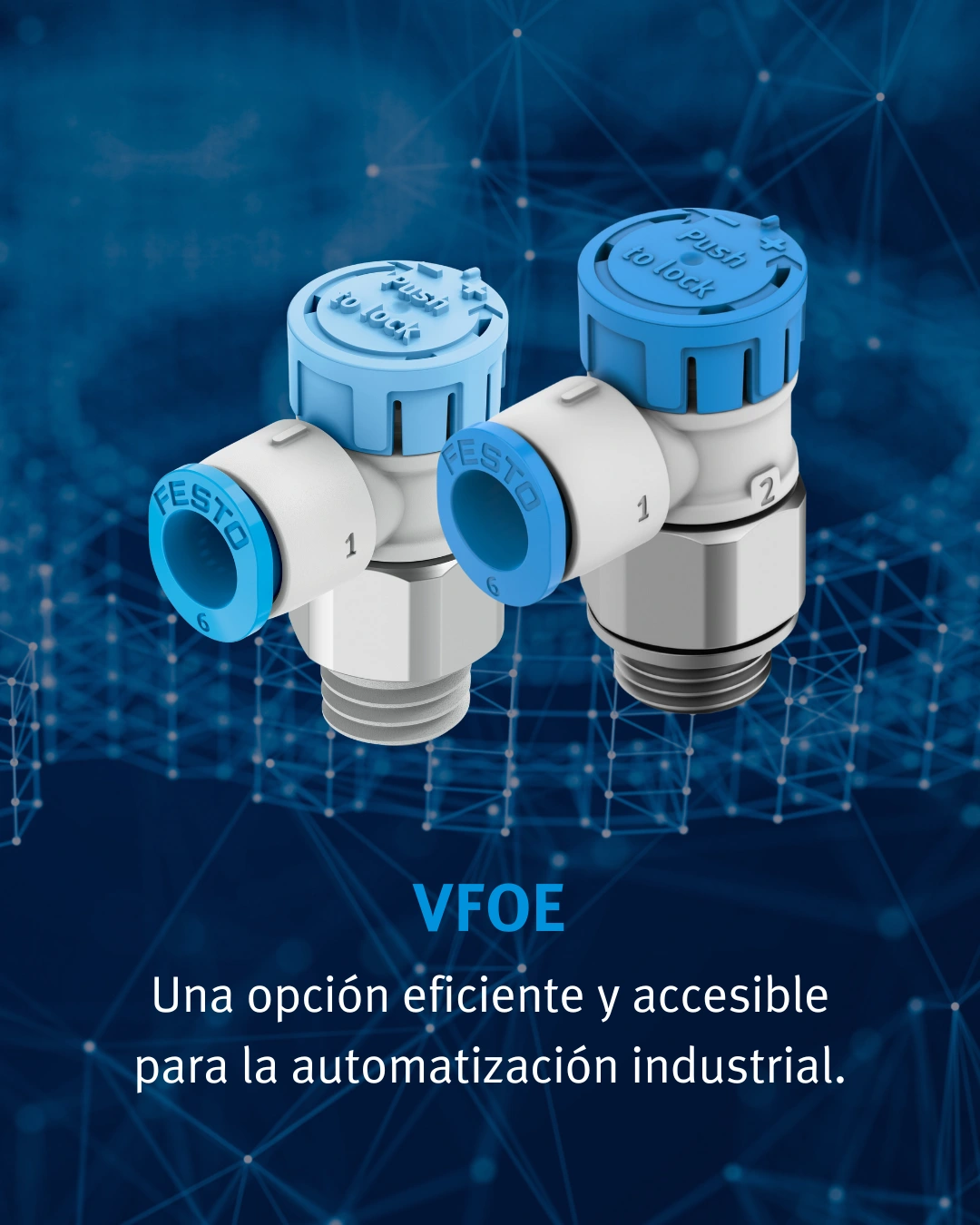
In this article we explain what a throttle and non-return valve does, when to use it and why the Festo VFOE has become a very interesting solution for standard industrial applications.
What is a throttle and non-return valve?
It is a pneumatic component designed to regulate air flow in one direction and allow free passage in the opposite direction.
Its main function is to control the displacement speed of a pneumatic actuator without affecting air return.
In other words:
- air flows freely in one direction
- in the opposite direction the flow is regulated
This principle allows much smoother and more controlled movements to be achieved.
What is it used for?
A throttle and non-return valve is used when you need to control:
- cylinder advance speed
- retraction speed
- cycle times
- smoothness of movement
- reduction of mechanical impacts
It is one of the most widely used elements in:
- industrial automation
- assembly lines
- packaging machinery
- electronics industry
- pneumatic manipulators
- manufacturing equipment
How does it work?
The operation is very simple.
When air flows in the regulated direction, it passes through a calibrated passage that limits the flow.
When air flows in the opposite direction, a non-return valve opens and allows virtually free passage.
This design offers precise motion control without penalizing system performance
Why control the speed of a pneumatic cylinder?
This is one of the most common questions among maintenance managers.
Correctly regulating speed allows you to:
- reduce vibrations
- avoid end-of-stroke impacts
- increase cylinder service life
- reduce guide wear
- protect sensors
- improve process repeatability
In many cases a small adjustment prevents breakdowns that generate hours of downtime.
What advantages does the Festo VFOE valve offer?
Among current pneumatic solutions, the Festo VFOE series is designed for standard applications where rapid installation, low cost and reliability are sought.
Their characteristics include:
Very compact design
It takes up very little space and can be installed directly on the actuator.
Ideal for machinery with limited available space.
Quick and secure adjustment
It incorporates the Push-to-Lock system, which allows flow regulation and locks the adjustment to prevent accidental modifications during operation.
Easy identification
The inlet and exhaust throttle versions are differentiated by colors, facilitating assembly and reducing installation errors.
Lower weight
Thanks to the use of polymeric materials it can be up to 50% lighter than previous generations of similar valves.
Wide variety of connections
Available in multiple thread sizes and quick connections to adapt to different pneumatic installations.
In which applications do we recommend the VFOE?
At ROYSE we usually recommend this solution for:
- industrial automation
- OEM machinery
- robotic cells
- assembly lines
- pick & place systems
- food industry
- pharmaceutical industry
- electronics
- component manufacturing
Its compact size particularly facilitates assembly when available space is limited.
ROYSE helps you choose the right solution
At ROYSE we work with leading manufacturers such as Festo to offer automation solutions adapted to each project.
We do not only supply pneumatic components; we help select the most efficient solution according to the application, optimizing performance, reliability and maintenance cost.
If you are designing a new machine or want to improve an existing installation, our technical team can advise you to choose the most suitable valve.
Frequently asked questions
What is the difference between a regulating valve and a throttle valve?
A regulating valve maintains a specific pressure.
A throttle valve regulates air flow to control actuator speed.
Should it be installed at the inlet or exhaust?
It depends on the application.
In most industrial pneumatic installations it is recommended to control the exhaust to achieve more stable movement, although there are applications where it is preferable to regulate the supply. The VFOE has versions for both configurations.
Is it suitable for confined spaces?
Yes.
Precisely one of the strong points of the VFOE series is its extremely compact and lightweight design.