
In any industrial environment, power transmission is one of the most critical elements for ensuring productivity, efficiency, and operational continuity. And within that system, industrial belts are a key component.
The problem is that many companies still use incorrect, oversized, or low-quality belts, causing:
- Performance losses
- Recurring breakdowns
- Unnecessary energy consumption
- Premature wear
- Avoidable production stoppages
Industrial-core spoiler: that ends up costing far more than investing in the right solution from the outset.
What are industrial belts?
Industrial belts are mechanical components designed to transmit power and motion between different parts of a machine using pulleys or synchronised systems.
Their main function is to ensure efficient, safe, and consistent transmission of mechanical energy.
Today, they are used in virtually all industrial sectors:
- Automotive
- Logistics
- Food industry
- Packaging
- Agriculture
- Heavy industry
- HVAC
- Robotics
- Industrial automation
- Continuous production systems
Choosing the right industrial belt directly affects:
- Energy efficiency
- Maintenance
- Machinery service life
- Operational profitability
And yes, a poor choice can become a black hole for maintenance. Literally.
Types of industrial belts
V-belts
V-belts are one of the most widely used solutions in conventional industrial applications.
They stand out for:
- Their versatility
- Ease of installation
- Good value for money
- Ability to absorb vibrations
They are commonly used in:
- Industrial fans
- Compressors
- Pumps
- Agricultural machinery
- HVAC systems
Industrial timing belts
Timing belts enable synchronised and precise transmission, preventing slippage between pulleys.
They are especially used in applications where precision is essential:
- Automation
- Robotics
- CNC machinery
- Packaging
- Production lines
- Positioning systems
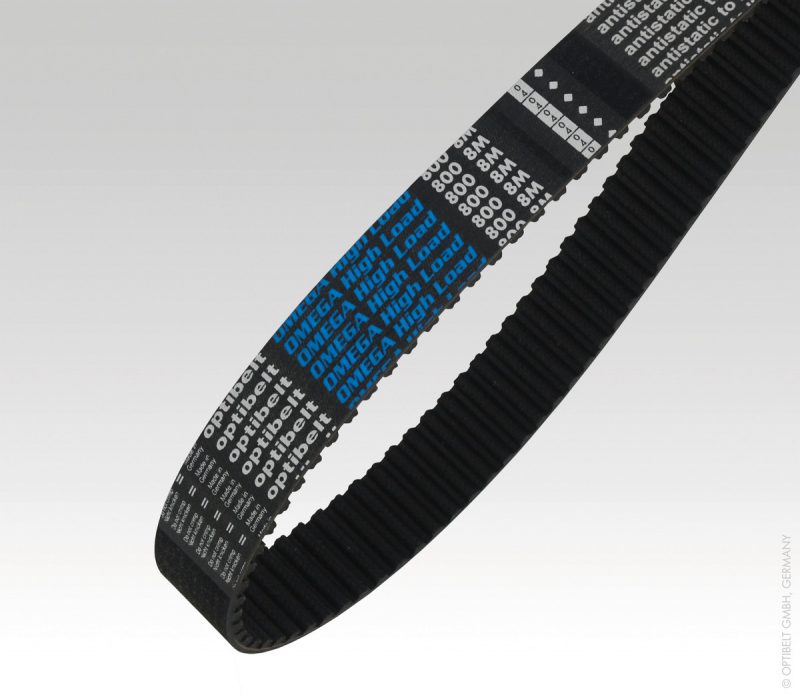
This is where one of the most advanced solutions on the market comes in: the Optibelt OMEGA High Load.
Optibelt OMEGA High Load: the high-performance industrial belt for demanding applications
When it comes to high-power industrial transmission, the Optibelt OMEGA High Load competes squarely in the premium category.
This timing belt has been developed specifically for applications subjected to:
- High dynamic loads
- High speeds
- Sudden tension changes
- Continuous operation
Why does it stand out compared to other industrial belts?
Greater transmission capacity
Optibelt OMEGA High Load technology allows up to 30% more power to be transmitted compared to conventional models.
This translates into:
- Higher performance
- Better energy utilisation
- Less mechanical stress on the system
For intensive industrial machinery, this is literally a competitive advantage.
Much longer service life
One of the biggest hidden costs in industry is unplanned maintenance.
The OMEGA High Load is designed with reinforced materials that significantly increase wear resistance, reducing:
- Premature breakages
- Excessive tension
- Mechanical fatigue
- Downtime
Result:
Fewer incidents and greater operational continuity.
And in production, continuity = money.
Quiet and stable operation
Thanks to the optimised geometry of its teeth, this industrial belt reduces vibration and noise even at high speeds.
This improves:
- Operator comfort
- Machinery stability
- Transmission system precision
Especially important in modern automated lines, where every micro-misalignment impacts productivity.
High energy efficiency
Energy efficiency is no longer optional in industry.
The Optibelt OMEGA High Load reaches efficiency levels of up to 98%, helping to reduce:
- Energy losses
- Overheating
- Electricity consumption
- Operating costs
In short: more output using fewer resources. Industrial KPI unlocked.
You can find more information on best practices in industrial energy efficiency at the International Energy Agency (IEA), an international reference for energy optimisation and industrial sustainability.
How to choose the best industrial belt?
Choosing an industrial belt correctly depends on several technical factors.
Required power
It is essential to correctly calculate the load and power the system must transmit.
An undersized belt causes premature wear.
An oversized one reduces efficiency and increases costs.
Operating speed
Not all belts can withstand the same rotational speeds.
In high-speed applications, high-performance timing belts such as the Optibelt OMEGA High Load deliver better results.
Temperature and working environment
Factors such as:
- Dust
- Humidity
- Chemicals
- High temperatures
- Abrasive environments
Directly affect belt durability.
That is why it is crucial to select suitable materials for each industrial environment.
Required precision
If the system requires exact synchronisation, timing belts are the best option.
In applications where slippage can cause errors or production losses, using a synchronous belt is essential.
Signs that an industrial belt needs replacement
Many companies wait too long before changing their industrial belts.
A classic mistake. And an expensive one.
These are some signs of wear:
- Visible cracks
- Loss of tension
- Excessive vibration
- Abnormal noise
- Overheating
- Uneven wear
- Misalignment
- Performance loss
Preventive maintenance prevents major breakdowns and reduces long-term operating costs.
Why trust Royse for your industrial belts?
At Royse, we help industrial companies optimise their power transmission systems with high-performance solutions tailored to each application.
We work with leading manufacturers such as Optibelt to offer:
- Premium industrial belts
- Specialised technical advice
- Automation solutions
- Energy optimisation
- Reduced mechanical incidents
It is not just about selling a belt.
It is about improving the reliability of your entire production.
Conclusion
Industrial belts are a fundamental component for ensuring the performance and efficiency of any industrial facility.
Choosing the right solution not only reduces breakdowns and maintenance, but also improves productivity, energy efficiency, and overall machinery profitability.
And when it comes to demanding applications, the Optibelt OMEGA High Load represents one of the most advanced and reliable options on the market.
At Royse, we help you find the industrial power transmission solution your company truly needs. Because in industry, every detail matters. A lot. ????
(FAQ)
What is the difference between a V-belt and a timing belt?
A V-belt transmits power through friction, while a timing belt uses mechanical synchronisation via teeth, preventing slippage.
How long does an industrial belt last?
It depends on:
- Quality
- Load
- Maintenance
- Working conditions
Premium industrial belts can offer a significantly longer service life compared to standard solutions.
What advantages does Optibelt have over other brands?
Optibelt stands out for:
- Technological innovation
- High efficiency
- Strength
- Precision
- Reliability in demanding industrial applications
How do I know which industrial belt my machinery needs?
It is recommended to carry out a technical analysis taking into account:
- Power
- Speed
- Load
- Environment
- Type of transmission